
Standard Practice for Qualitative Adhesion Testing of Metallic Coatings
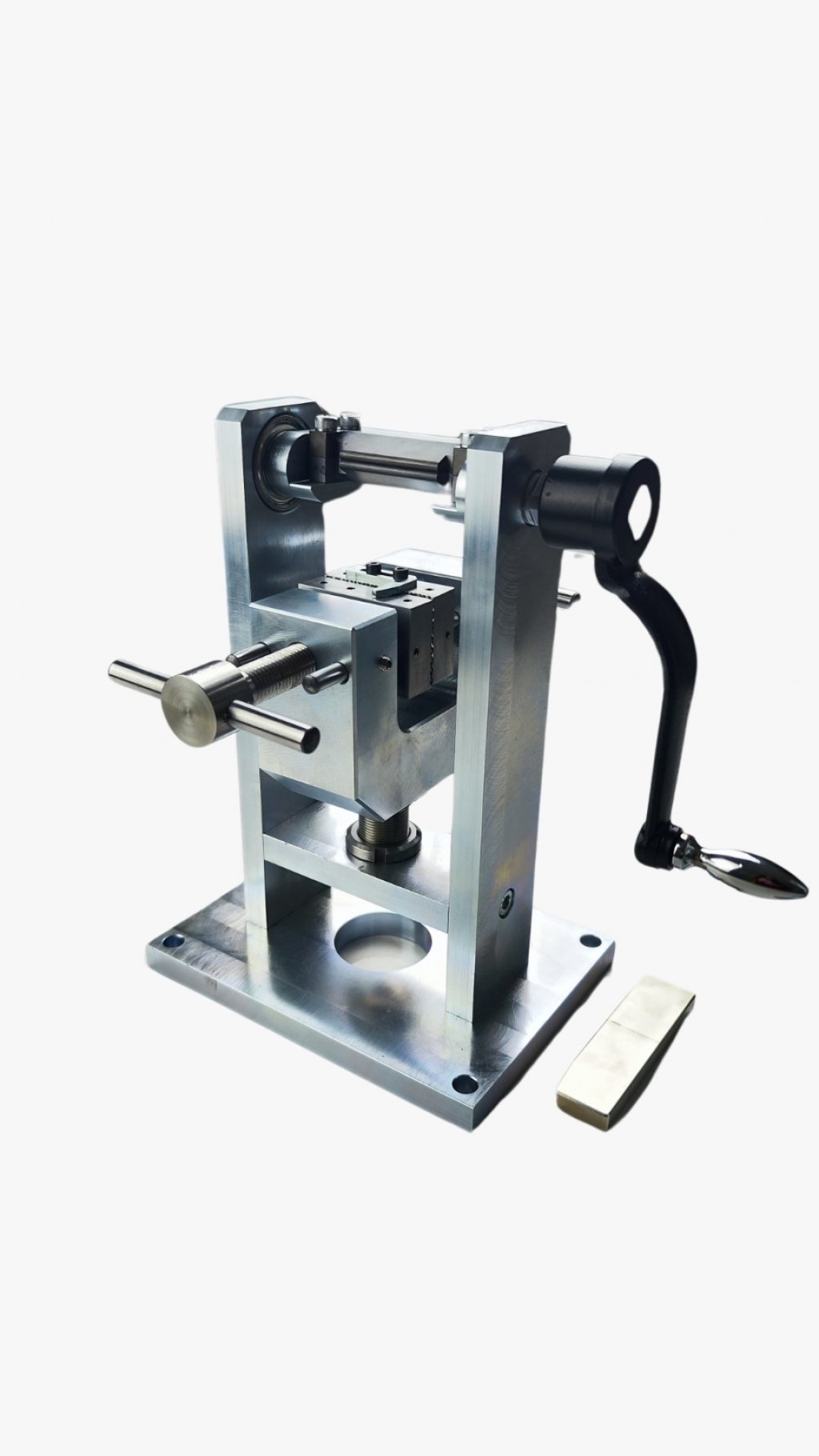
Test Fixture:
According to ASTM B 571 standard: the part is repeatedly bent back and forth at a 180° angle until failure occurs in the base metal. Examine the area at low magnification (e.g. 10x) for separation or peeling of the coating. Lifting with a sharp knife will indicate poor adhesion due to the coating lifting off.
Mandrel diameter should be 4 times the sample thickness. Mandrels are designed and produced in accordance with ASTM B 571 standard according to the sample thickness.
Material: Steel with coating
Weight: Approx. 15 kg
ASTM B571 is a standard test method for evaluating the adhesion strength of metallic coatings. This method applies a cutting or peeling force to measure the coating's resistance to separation from the substrate.
Test Method:
The ASTM B571 test is performed on a coated specimen mounted in a special fixture on a testing machine. A force is applied to the coating, increasing until it separates from the substrate. The force is measured with a load cell, and the separation is monitored with an extensometer.
Test Results:
The results of the ASTM B571 test are reported in pascals (Pa) or pounds-force per square inch (psi) of adhesion strength between the coating and the substrate. A higher adhesion strength value indicates a stronger bond.
Applications:
The ASTM B571 test is used to evaluate the adhesion strength of a variety of metallic coatings. This test is widely used in various industries, including:
Benefits of ASTM B571 Testing:
Contact us to get more detailed information about test fixtures and to request a quote!


Copyrights © 2021 All Rights Reserved


